

Page 1

A Québécois Christmas Feast

Delicious excess at La Cabane d’à Côté

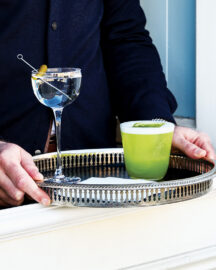
When you enter La Cabane d’à Côté, you will find an apéritif already waiting for you — a glass of cranberry cider, pressed by hand on-site, or maybe a Cosmo de Noël, made with gin and cranberry syrup — along with a spread of the most enticing snacks, all arrayed on the sideboard in the kitchen. To warm your spirits further, look to the cauliflower soup spiked with lardons and gobs of Hercule de Charlevoix cheese. Expect oysters, a terrine of local foie gras, cured trout dressed with Campari-cured root vegetables and crème fraîche.… And this is just the beginning — the opening hour of your feast, spent snacking and drinking while you watch four valiant cooks meticulously preparing your meal without any assistance from combi ovens or immersion circulators or any such contemporary shortcuts. Everything here is cooked on the evaporation table or over its live wood fire.

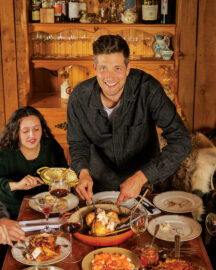
“Here, it’s not the typical restaurant experience where you walk in, wait to be seated, sit for two hours to eat and drink, then get up and leave,” explains chef and partner Vincent Dion Lavallée. “What I love is going somewhere where you can make yourself at home, feel like you’re in your family’s or friends’ cabin, and move around freely.”

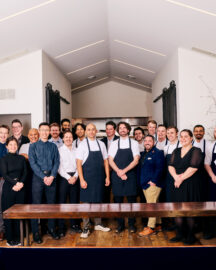
The PdC all-stars getting started with snacks and apéros.
What I love is going somewhere where you can make yourself at home… Chef and Partner at La Cabane d’à Côté Vincent Dion Lavallée
LEFT TO RIGHT Antony Labelle, Michael Picard, Matthew Babin, Vincent Dion Lavallée, Philippe Labelle.

Having worked with chef Martin Picard’s iconic Au Pied de Cochon restaurant group for 15 years — including the last eight as co-owner — Dion Lavallée makes no secret of his love of tables so well-stocked they verge on excess. Christmas is “traditional all the way.” For him that means terrines, tourtières, and pork shank ragout.

The holidays are an especially frantic time for the habitually busy restaurateur, who along with running La Cabane d’à Côté is charged with supervising the neighbouring Cabane à Sucre Au Pied de Cochon, their cidery, gardens and the tapped maple forest.

So, when he’s finally done with managing other people’s Christmas parties at the Cabane d’à Côté, Dion Lavallée sets off for his own country house, in the regional county of L’Érable (really), with his brother and parents, his girlfriend and their children.

The chef always buys his provisions from the same places: sweets from La Cabane sur le Roc, owned by friend and neighbour Gabrielle Rivard-Hiller, a former employee of Au Pied de Cochon and author of the beautiful book Les Saisons de Gabrielle; charcuterie from Viens; trout from Bar St-Denis; logs from Pâtisserie Rhubarbe; bread from Automne Boulangerie; and cheeses (Porto Stilton, Hercule de Charlevoix, Pont Blanc, Vacherin Mont-D’or) from La Fromagerie Hamel. “And it’s not Christmas if I don’t have tourtière for breakfast at least one morning!”

Recipes

Cosmo de Noël

Yield: 1

INGREDIENTS

  • 30 ml (1 oz) dry gin
  • 15 ml (½ oz) Noroi Cranberry Liqueur (or Cointreau)
  • 15 ml (½ oz) cranberry syrup
  • 15 ml (½ oz) lime juice
  • 30 ml (1 oz) chilled cranberry cider
  • 1 sprig balsam fir

METHOD
Combine gin, liqueur, cranberry syrup and lime juice in a shaker over ice. Shake vigorously and strain into a chilled Martini glass. Top with cider and garnish with a sprig of fir.


Confit Trout with Citrus Salad and Campari-cured Carrots

Serves 6

INGREDIENTS
Rutabaga and Carrots

  • 25 g (2 oz) rutabaga, trimmed into a cylinder and sliced on a mandoline
  • 25 g (2 oz) Nantes carrots, peeled, sliced on a mandoline
  • 75 ml (⅓ cup) lemon juice
  • 75 ml (⅓ cup) maple syrup
  • 50 ml (¼ cup) Campari
  • 5 g (1 tsp) salt

Trout

  • 1 boneless trout filet, 200 g (½ lb)
  • 3 g (1 tsp) maple sugar
  • 3 g (1 tsp) sea salt
  • 75 ml (⅓ cup) olive oil
  • zest of 1 lemon
  • pepper

Horseradish Crème Fraîche

  • 50 ml (¼ cup) crème fraîche
  • 50 ml (¼ cup) grated horseradish
  • 10 ml (2 tsp) lemon juice
  • salt and pepper

Citrus Salad

  • 1 blood orange cut into suprêmes
  • 1 orange cut into suprêmes
  • 1 grapefruit cut into suprêmes
  • 100 ml (½ cup) citrus juice
  • 2 kumquats, thinly sliced
  • 25 ml (2 tbsp) trout roe
  • 25 ml (2 tbsp) olive oil
  • 5 ml (1 tsp) lemon juice
  • salt and pepper

METHOD
Bring a saucepan of salted water to a boil on high. Blanch rutabaga and carrot for about 1 minute; drain and let cool to room temperature. In a medium bowl, combine lemon juice, maple syrup, Campari, 50 ml (¼ cup) water and salt. Add vegetables and transfer to the refrigerator to marinate for a minimum of 24 hours.

Preheat oven to 105C (225F).

Arrange trout on a tray, skin-side down. Combine sugar and salt and rub on flesh side. Transfer to the refrigerator to cure for 1 hour. Add oil to an oven-proof dish that will snugly accommodate trout. Add fish (do not rinse), flesh-side down, and transfer to oven until it reaches an internal temperature of 45C (113F) and flakes easily — 15 to 20 minutes. Transfer fish to plate, remove skin, garnish with zest and season with pepper. Set aside.

Transfer crème fraîche to a bowl and whisk until loose. Incorporate horseradish and lemon juice. Season to taste and set aside. Combine blood orange, orange and grapefruit in a medium bowl. Use a slotted spoon to transfer rutabaga and carrot from marinade to bowl. Add kumquat and roe. Season with a little Campari marinade. In another bowl, whisk together mixed citrus juices, olive oil and lemon juice. Season. To finish, pour citrus vinaigrette onto a platter and top with room-temperature trout, broken into chunks. Garnish with citrus salad and crème fraîche.


Crème de chou-fleur / Cream of Cauliflower Soup

Serves 6

INGREDIENTS

  • 100 g (4 oz) cold butter
  • 1 yellow onion, sliced
  • 1 sprig thyme
  • 1 head cauliflower, cut into pieces
  • 500 ml (2 cups) chicken stock
  • 400 ml (1⅔ cups) whole milk
  • 250 ml (1 cup) double cream
  • salt, pepper
  • 500 g (1 lb) slab bacon, cubed
  • 1 Honeycrisp apple, sliced very thinly on a mandoline
  • 500 g (1 lb) grated Hercule de Charlevoix (or similar Alpine cheese, like raclette)
  • 100 g (4 oz) beurre noisette


METHOD
Heat the butter in a saucepan. Heat 75 g (⅓ cup) butter in a saucepan on medium-low. Add the onion and thyme and sweat until onion softens — about 10 minutes. Add the cauliflower, stock, milk and cream. Bring to a simmer and then cook, uncovered, until cauliflower is cooked through and soft, and liquid is reduced by half — about 30 minutes. Transfer to a blender and blitz until smooth. Pass through a fine-mesh sieve into a saucepan. Reheat, whisk in remaining cold butter, season and keep warm. In a skillet on medium-low, cook bacon until bronzed. Preheat broiler.

Divide soup among 6 oven-proof bowls arranged on a baking sheet. Top each bowl with a few slices of apple, a drizzle of bacon fat and the cheese. Broil (like a French onion soup) until cheese is bronzed and bubbling. Drizzle with beurre noisette and serve.


Tourtière de Noël

Yield: 4 tourtières
Serves 6 each

INGREDIENTS
Pork Shoulder

  • 1 kg (2 lb) deboned pork shoulder, cubed
  • 2 g (¾ tsp) ground cinnamon
  • 2 g (¾ tsp) ground clove
  • salt and pepper

Filling

  • 50 g (¼ cup) butter
  • 400 g (2½ cups) minced onions
  • 20 g (1½ tbsp) minced garlic
  • 175 g (1¾ cups) chopped button mushrooms
  • 50 ml (¼ cup) apple cider or white wine
  • 1 kg (2 lb) ground pork
  • 15 g (1½ tbsp) salt
  • 1 g (¼ tsp) ground cinnamon
  • 1 g (¼ tsp) ground clove
  • 540 g (3 cups) grated potatoes
  • 175 ml (¾ cup) broth from braised pork shoulder

Tart Bottom

  • 600 g (5 cups) flour
  • 10 g (1 tbsp) salt
  • 300 g (10 oz) cold butter, cubed
  • 1 egg, beaten

Pâte Brisée

  • 550 g (4½ cups) flour
  • 450 g (1 lb) cold butter, cubed
  • 10 g (1 tbsp) salt

To Finish

  • 1 egg yolk, beaten with water or cream

METHOD
Preheat oven to 175C (350F).

Combine pork shoulder and spices in a roasting pan and season. Add water to come partway up the pork. Cover pan snugly with foil. Transfer pan to the oven until meat is tender and falling apart — about 3 hours. Strain and reserve cooking liquid. Shred meat and set aside to cool.

For the filling, heat butter in a large Dutch oven on medium. When the butter foams, add onions and garlic and sweat until softened. Add mushrooms and cook until their liquid has evaporated. Deglaze with cider (or wine). When it has reduced to a syrup, add ground pork, salt, cinnamon and cloves. Cook for 10 minutes, stirring to break up the meat. Add potatoes and 175 ml (¾ cup) reserved broth from the braised shoulder. Cook, stirring occasionally, until potato is soft and the pork is firm — about 10 minutes. Adjust seasonings and transfer to a tray to cool.

For the tart bottom, combine flour and salt on a work surface and cut in the butter with a pastry cutter. When the mixture resembles coarse crumbs, form a well at the centre, add egg and 170 ml (¾ cup) of cold water and incorporate. Knead gently until the dough comes together. Form into a ball, wrap snugly in cling film and transfer to the refrigerator for 3 hours. Lightly flour 4 23-cm (9 inch) pie plates. Roll dough out to a thickness of about 4 mm (⅛”). Cut out 4 rounds large enough to reach the edges of the pie plates. Line pie plates with dough and transfer to the refrigerator.

To make the pâte brisée, combine flour, butter and salt in the bowl of a food processor and pulse until crumbly. Add 70 ml (⅓ cup) cold water and pulse until the dough comes together. Do not overprocess (there should be pieces of butter visible in the dough). Transfer dough to a work surface and form into a ball. If it doesn’t hold together, work in more cold water. Wrap the dough in cling film and set aside in the refrigerator for 4 hours. Let dough rest at room temperature for 30 minutes, then roll to a thickness of about 4 mm (⅛”). Cut 4 25-cm (10 inch) rounds from the dough. Arrange on a parchment-paper-lined baking sheet and transfer to the refrigerator.

To assemble the tourtières, remove dough-lined pie plates from the refrigerator. Divide meat filling between the 4 pies and mound at centre. Repeat with the braised pork shoulder. Brush the edges of each pastry base with water. Top with 1 disk of pâte brisée, press edges together and crimp to seal. Using a sharp knife, cut 3 vents in each top crust. Freeze tourtières, uncovered, until solid; then wrap in several layers of cling film. Keep frozen until the holiday season (or up to 4 months).
Preheat oven to 225C (425F).

Transfer frozen tourtière(s) to a baking sheet. Brush with egg wash, then transfer to middle rack for 30 minutes. Lower heat to 175C (350F) and bake until pastry is bronzed and base is cooked — about 90 minutes. Set tourtière(s) aside to rest 10 minutes before serving.

It’s not Christmas if I don’t have tourtière for breakfast at least one morning! Vincent Dion Lavallée

Ragoût de pattes / Pork Hock Ragout

Serves 8

INGREDIENTS


Meatballs

  • 500 g (1 lb) ground pork
  • 75 g (½ cup) minced onions
  • 2 eggs
  • 60 ml (¼ cup) heavy cream
  • 50 g (½ cup) breadcrumbs
  • 10 g (1 tbsp) minced garlic
  • 10 g (1 tbsp) salt
  • pepper
  • 1 pinch ground clove
  • 1 pinch ground cinnamon
  • 1 pinch nutmeg


Ragout

  • 100 ml (⅓ cup) canola oil
  • 1.3 kg (2¾ lb) skin-on pork hock, cut crosswise like osso bucco, about 5 cm (2”) thick
  • 250 g (½ lb) skin-on onions, halved and charred
  • 200 g (1¼ cup) chopped carrots
  • 200 g (7 oz) small potatoes
  • 4 g (2 tsp) minced garlic
  • ½ bunch parsley
  • 1 pinch ground cinnamon
  • 1 pinch ground clove
  • 1 pinch ground savory
  • salt and pepper


Roux

  • 100 g (½ cup) rendered pork fat
  • 100 g (¾ cup) flour


Garnish

  • pickled beets
  • pickled gherkins

METHOD


Combine all meatball ingredients. Working with about 35 g (2 tbsp) of the mixture at a time, form into balls and arrange on a baking sheet. Refrigerate for 24 hours.

To make the ragout, heat a Dutch oven on medium-high and add the oil. When the oil shimmers, sear the meatballs in batches until lightly browned on all sides; set aside. Sear the pork hock pieces until bronzed on all sides. Add cold water to cover and follow with all remaining ingredients except the pepper. Bring to a boil, reduce to a simmer and cover. When the potatoes are tender (about 20 minutes) remove and set aside. Skim fat from surface periodically and reserve (for the roux). Cook until meat is tender and separates easily from the bone — about 3 hours. Remove hocks, onions and carrots from the braising liquid and set aside to cool under cling film. Discard onion skins. Add meatballs to the pot, simmer for 10 minutes and, with a slotted spoon, transfer to a baking sheet. Skim fat again and reserve. Strain braising liquid through a fine-mesh sieve and reserve. Debone the pork, reserving the meat and skin. Combine with the cooked onions, carrots and potatoes.

To finish, heat 100 g (½ cup) of rendered pork fat in a Dutch oven on medium. Add flour and cook, whisking until it browns — about 3 minutes. Slowly add the reserved braising liquid to the roux and whisk to form a smooth sauce. Simmer for 5 minutes. Add reserved meatballs, pork, carrots, onions and potatoes. The sauce should coat the back of a spoon. If it seems thin, add 1 tbsp cornstarch diluted in cold water and stir. Add pepper, correct seasonings and serve with pickled beets and gherkins.


Sucre à la Crème au Sirop d’Érable / Maple Fudge

Serves 6

INGREDIENTS

  • 500 ml (2 cups) maple syrup
  • 250 ml (1 cup) heavy cream
  • 35 g (3 tbsp) unsalted butter
  • whole walnuts, toasted

METHOD
Line a 23 x 13 cm (9 x 5 inch) pan with parchment paper.

Combine syrup, cream and butter in a saucepan. On high, without stirring, heat the mixture to 114C (237F). Transfer it to a large non-reactive bowl and whisk vigorously.

As soon as the mixture begins to thicken, transfer to the paper-lined pan and garnish with walnuts. Set aside to cool on the countertop and then cut into squares.

– Ève Dumas

Advertisement